Sarah Grace Mortgages Ltd
UK mortgage brokerage. November 2025 to July 2026.
Where the business was
The business was profitable and growing, with a founder who had a clear long-term vision and no shortage of ambition. But growth had reached the point where the way the business was run needed to catch up with its size.
The founder had already invested significant time and effort in improving the business, including working with a business coach and a consultant. Both brought useful ideas, but those ideas did not become part of how the business operated day to day.
The issue was not a lack of insight or commitment. What the business was missing was a simple, practical structure that could turn ideas into consistent action.
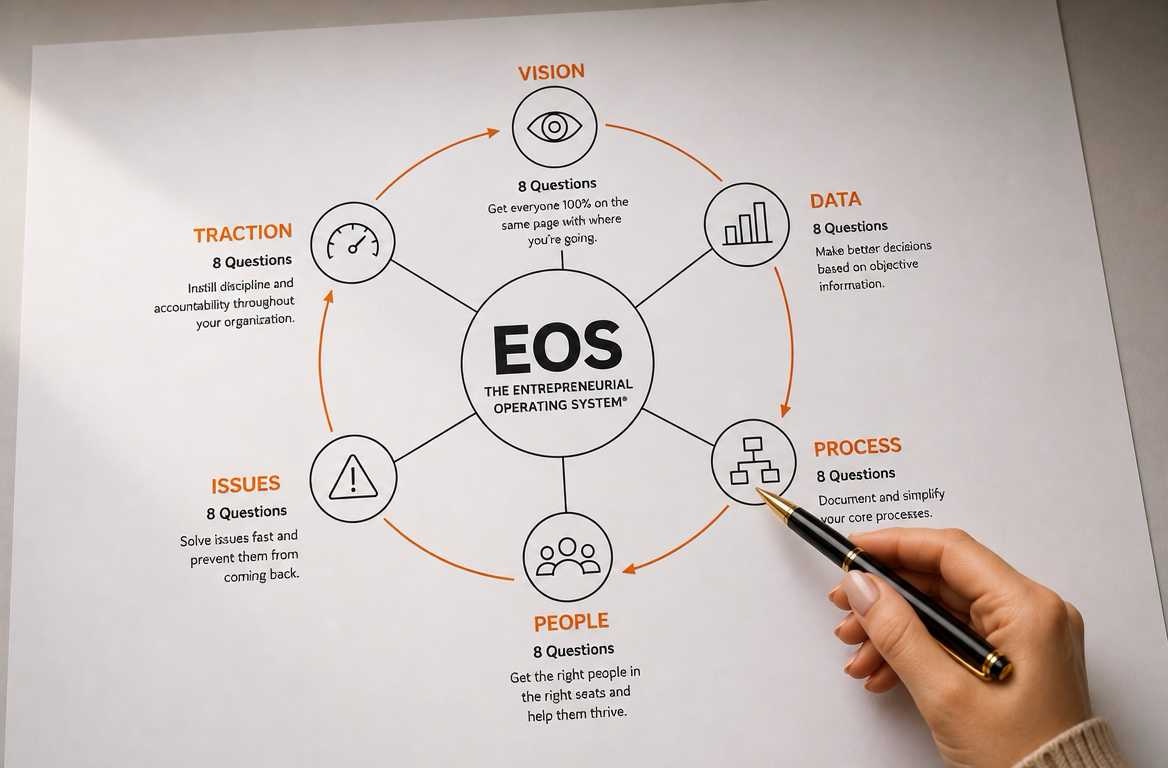
After reading Traction, the founder recognised that this structure was the missing link. The principles made sense but introducing them and embedding them across the business required experienced support.
Rather than recruiting a full-time operations director, the founder brought in Sylvie as a fractional Integrator: providing senior operational leadership to help establish the structure, translate it into practical ways of working and ensure it became embedded without the long-term overhead of a permanent hire.
What Sylvie helped us put in place
Working inside the business alongside the founder and leadership team, Sylvie helped build the foundations of a simple operating system:
- Clear ownership, so every area of the business had a named owner
- A small set of meaningful numbers, reviewed on the same day each week
- Quarterly priorities, each with a single owner and a clearly defined outcome
- A weekly leadership meeting that produces decisions rather than simply sharing updates
- A regular financial review rhythm
- A shared understanding of the direction of the business that the whole team could describe
The value was not simply in introducing the tools. It was in helping us adapt them to the business and embed them until they became part of how the company operates on an ordinary Tuesday.
What changed
- Decisions are made by the people who own them, rather than continually routing back to the founder
- Priorities agreed at the beginning of a quarter remain active through to the end
- Performance is consistently visible, rather than reconstructed after the fact
- The leadership team runs and protects its own operating rhythm, even when the week becomes difficult
- The founder has greater headspace to lead the business rather than constantly unblocking it
Client reflection
“Reading Traction helped me realise that what we had been missing was a simple business structure. We had received useful advice before, but without that underlying structure, it was difficult to turn the ideas into consistent ways of working.
Sylvie helped us take that understanding and put it into practice. Working with her as our fractional Integrator has brought focus, rhythm and accountability to the business. I’ve reclaimed headspace, strengthened our processes and gained confidence in our decisions because I’m no longer making them in isolation.
The real difference has been implementation. Sylvie didn’t just introduce a framework; she helped us build the right structure for our business and embed it until the leadership team could carry it forward themselves.”
Data and Technology Services Ltd
Smart home and business security. March 2026
Where the business was
A growing technology business where the Director remained involved across most areas of the company. As it grew, balancing strategic leadership against day-to-day operational responsibility became steadily harder.
Priorities were unclear. Decision-making was heavily centralised. There was no consistent operating structure, so execution was uneven and the team depended on the Director for direction and approval.
What we put in place
- An Accountability Chart defining roles, responsibilities and ownership across the organisation
- Scorecards, so performance was visible at individual and team level
- A consistent leadership meeting rhythm, to strengthen alignment and follow-through
What changed
Team members became confident making decisions independently, which removed the Director as the approval route for day-to-day work. Ownership is clearer, communication is stronger, and execution is more consistent across the business.
“The work we've done together has genuinely transformed how we operate as a business. We now have the clarity, structure and confidence to move forward at pace, without everything depending on me.” — Dave Small, Director, Data and Technology Services Ltd

Structure inside 90 days. Independence over the six to nine months that follow.
The first quarter puts the foundations in: ownership, scorecards, quarterly priorities and a meeting rhythm that fits the business. That part is fast and you feel it quickly.
Genuine independence takes longer, because it is a habit rather than a framework. Sarah Grace Mortgages took nine months to reach handover. That is a normal shape for this work, and anyone promising a self-running business in ninety days is describing the structure, not the outcome.
Implementation, not another set of recommendations.
Following the UK Enterprise Award, SME News asked me to explain the thinking behind the work. The short version: founders rarely need another framework explained to them. They need an experienced operator willing to step inside the business and make the agreed structure part of everyday working life.
“The frameworks are a means to an end: a business that runs without the founder needing to hold everything together.”Read the full SME News feature
Recognition
In 2026 Cowell & Co was named Operating System Integrator of the Year at the SME News UK Enterprise Awards, and Business Consultancy of the Year by The Business Awards UK.
Awards support evidence. They do not replace it, which is why they are at the bottom of this page.
Do you recognise the pattern in your own business?
Forty-five minutes is enough to work out whether what is holding you back is structural, what would need to change first, and whether I am the right person for it. No preparation, no pitch. If the answer is that you do not need me, I will say so.
For interviews, speaking and contributor enquiries, contact me directly.